
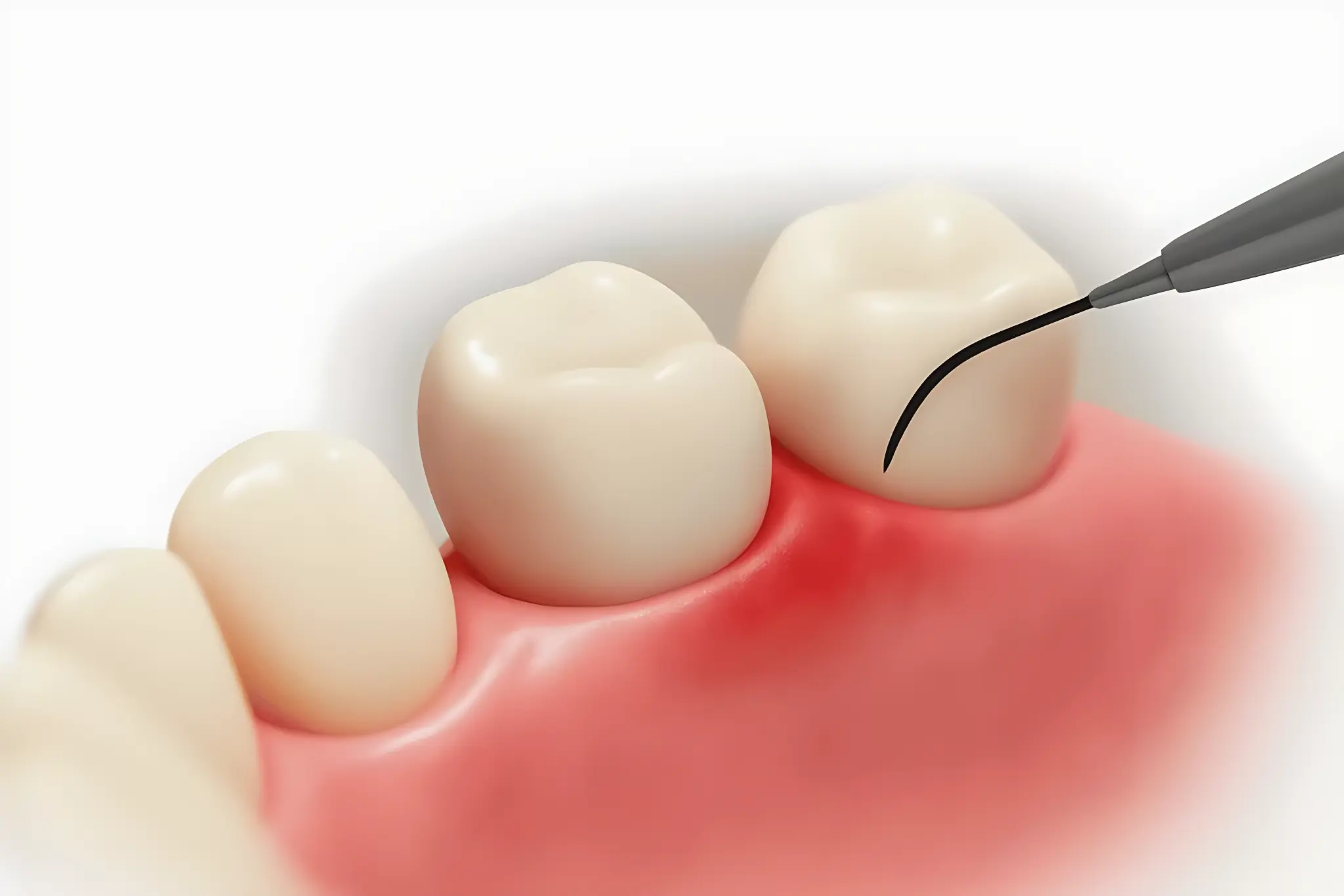
Gum treatment involves the examination and treatment of issues such as bleeding gums, swelling, inflammation, halitosis (bad breath), gum recession, and loose teeth. If your gums are bleeding, it is incorrect to simply dismiss it by saying "it happened because of the brush." The underlying cause of the bleeding must be clarified through a clinical dental examination.
Table of Contents
OpenGum diseases often begin silently. Initially, bleeding during brushing, bad breath, and gum sensitivity occur. If the problem is not examined in time, the inflammation can deepen, leading to the formation of periodontal pockets and loose teeth.
The goal of gum treatment is not just to stop the bleeding. The primary objective is to identify the cause of the inflammation, remove dental calculus (tartar) and bacterial plaque, control periodontal pockets, and protect the supporting tissues of the teeth.
What is Gum Treatment?
Gum treatment is a therapeutic process performed to eliminate bacterial plaque and tartar accumulating on the gums, the supporting tissues of the teeth, and beneath the gumline. This treatment may be required in cases such as gingivitis, periodontitis, periodontal pockets, bleeding gums, and loose teeth.
In dentistry, this field is called periodontics. Periodontics does not solely focus on the gums; it also monitors the tissues that anchor the tooth to the bone. In other words, the problem is not just at the "reddened gums" level; it can sometimes be related to the tooth's support system.
Gum treatment typically comes to the forefront in the following situations:
- If the gums bleed during brushing;
- If there is swelling and redness in the gums;
- If bad breath persists for a long time;
- If there is gum recession;
- If the spacing between teeth has increased;
- If loose teeth are noticed;
- If dental calculus accumulates frequently;
- If the dentist mentions the presence of a periodontal pocket.
Some patients consider bleeding gums to be a minor issue. However, recurring bleeding can be the first warning sign of gum disease. Therefore, a gum treatment plan should be arranged without delay.
What Problems Does Periodontics Address?
Periodontics is the branch of dentistry that deals with the gums, the supporting bone of the teeth, the periodontal ligaments, and the tissues surrounding the tooth root. A periodontist evaluates problems such as bleeding gums, gingivitis, periodontitis, periodontal pockets, gum recession, and loose teeth.
Patients can understand it simply this way: even if the visible part of the tooth appears healthy, its supporting tissues may be weakening. This is precisely why gum disease is dangerous. When treatment is delayed, it is not the tooth itself that is damaged, but the foundational support tissue holding it in place.
During the examination, a periodontist does not just look at the bleeding area. The location of tartar, the depth of periodontal pockets, tooth mobility, oral hygiene habits, and, if necessary, X-ray results are evaluated together.
What Causes Bleeding Gums?
Bleeding gums are most commonly associated with dental calculus, bacterial plaque, and gum inflammation (gingivitis). Bleeding can occur during brushing, when eating hard food, or spontaneously. If this symptom recurs, it is necessary to consult a dentist for gum treatment.
One of the most common causes of bleeding gums is plaque accumulating around the necks of the teeth and below the gumline. Over time, this plaque hardens and turns into tartar. Tartar irritates the gums, creates inflammation, and can lead to bleeding.
Some patients reduce teeth brushing because of the bleeding. However, this only worsens the problem. As cleaning becomes inadequate, more plaque accumulates, and the gum inflammation can deepen.
Bleeding gums can be related to the following factors:
- Tartar and plaque accumulation;
- Gingivitis;
- Periodontitis;
- Incorrect or aggressive brushing;
- Smoking;
- Poor oral hygiene;
- Certain systemic health conditions;
- Hormonal changes during pregnancy;
- Side effects of certain medications.
The first step in gum treatment is finding the cause of the bleeding. It is incorrect to mask the problem for a long time using only mouthwashes, gels, or home remedies without knowing the source.
What Symptoms Indicate a Need to Consult a Dentist?
If bleeding gums persist for several days, or if there is gum swelling, pus, bad breath, gum recession, or loose teeth, consulting a dentist should not be delayed. These symptoms can indicate a transition from gingivitis to a deeper, more advanced gum disease.
A gum examination is absolutely necessary in the following cases:
- Gums bleed during brushing;
- There is swelling and redness in the gums;
- Bad breath does not go away for a long time;
- Pus comes out of the gums;
- Teeth appear longer than before;
- Spacing between teeth is increasing;
- Teeth feel loose;
- Pain occurs during chewing.
All of these symptoms might not appear at the same time. Sometimes, a patient only notices bleeding, but a professional dental examination can reveal periodontal pockets and hidden tartar issues.
What is the Difference Between Gingivitis and Periodontitis?
Gingivitis is the early stage of gum inflammation. Periodontitis, on the other hand, is a condition where the inflammation has spread to the deeper supporting structures of the teeth. If gingivitis is treated on time, results are achieved much faster. In periodontitis, gum treatment requires a more comprehensive and structured plan.
During gingivitis, the main issues are redness, swelling, and bleeding of the gums. At this stage, there may be no serious loss in the bone tissue holding the teeth. Therefore, early intervention is vital.
In periodontitis, the inflammation deepens. Pockets form between the tooth and the gum, tartar can accumulate inside these pockets, and the tooth's support structure weakens. If not treated in time, the risk of tooth mobility and tooth loss can increase.
| Feature | Gingivitis | Periodontitis |
|---|---|---|
| Main Problem | Gum inflammation | Damage to the supporting tissues of the teeth |
| Symptoms | Bleeding, redness, swelling | Bleeding, pockets, bad breath, loose teeth |
| Treatment | Dental scaling, hygiene education, regular check-ups | Deep cleaning, root planing (curettage), sometimes surgical approaches |
| Risk | Easier to manage if addressed on time | Risk of tooth loss can increase if delayed |
How is Gingivitis Treated?
The primary goal in gingivitis treatment is to remove the plaque and tartar that irritate the gums. The dentist performs dental scaling, assesses the condition of the gums, and explains correct home care to the patient, including the use of standard toothbrushes, dental floss, or interdental brushes.
If the patient seeks help during the gingivitis stage, the gums usually recover smoothly. However, clinical cleaning alone might not be enough. If daily home hygiene is not maintained, the bleeding can return.
Gum treatment at this stage is generally simpler. In some cases, the doctor may recommend an antiseptic mouthwash or additional care products. These do not replace the primary treatment; the core issue remains the professional removal of tartar and plaque.
How is Periodontitis Treated?
In periodontitis treatment, periodontal pockets, calculus beneath the gumline, root surfaces, and the supporting structures of the teeth are evaluated together. At this stage, gum treatment can be much deeper than standard dental scaling. In some cases, closed curettage, open curettage, or tooth splinting becomes necessary.
The goal in periodontitis is to bring the disease under control. Periodontal pockets must be cleaned, the bacterial load must be reduced, and the patient's home hygiene routine must be corrected. If there is tooth mobility, the dentist evaluates the probability of saving the teeth separately.
At this stage, thinking "I had it cleaned once, the problem is gone" is incorrect. Regular dental follow-ups are crucial after periodontitis treatment, as the disease can become active again.
How is Periodontal Pocket Treatment Performed?
A periodontal pocket is a deepened space between the tooth and the gum. Bacteria, plaque, and tartar can accumulate inside this pocket. The goal of periodontal pocket treatment is to clean that area, reduce inflammation, and prevent the gum disease from progressing deeper.
Healthy gums fit snugly around the teeth. When gum inflammation deepens, the space between the tooth and the gum increases. Patients often do not feel this, but a dentist can measure the depth of these pockets using a periodontal probe.
When periodontal pockets are deep, it is impossible to clean that area with standard brushing. Tartar remains beneath the gumline and keeps fueling the inflammation. Therefore, at this stage, gum treatment requires deep cleaning.
The treatment of periodontal pockets can be carried out through the following stages:
- Periodontal examination
- Measurement of pocket depth
- X-ray evaluation
- Scaling (removal of plaque and tartar)
- Decision on closed or open curettage
- Oral hygiene instructions
- Follow-up examination
Is Dental Scaling Different from Deep Gum Treatment?
Yes, they are different. Standard dental scaling is mainly the removal of tartar and plaque accumulating on the visible surfaces of the teeth and along the gumline. Deep gum treatment, however, also involves cleaning tartar located beneath the gums, inside periodontal pockets, and on the root surfaces.
Patients sometimes say, "I had my tartar cleaned, but the bleeding is still there." The reason for this could be the tartar remaining under the gumline and deep pockets. In such cases, standard cleaning alone may not be sufficient.
| Treatment Type | Why is it performed? | When is it sufficient? |
|---|---|---|
| Standard Scaling | To clean visible tartar and plaque | For mild gingivitis and superficial tartar |
| Deep Cleaning | To clean tartar under the gumline and the root surface | For periodontal pocket and periodontitis risks |
| Curettage | To deeply clean inside the pocket and inflamed tissue | For deeper pockets and by dentist indication |
When is Closed and Open Curettage Performed?
Closed and open curettage are periodontal treatment methods used to clean gum pockets. Closed curettage is a less invasive approach. Open curettage, on the other hand, may be preferred for deeper pockets and cases where the dentist needs to perform the cleaning under direct visualization.
The decision for curettage is made based on the examination findings, not the patient's preference. The dentist evaluates the depth of the periodontal pocket, the location of the tartar, X-ray results, and the condition of the tooth's support structures.
Dental scaling and hygiene training are usually performed before curettage. Then, the response of the gums is monitored. If deep pockets persist, closed or open curettage may be discussed.
What is Closed Curettage?
Closed curettage is the cleaning of periodontal pockets and root surfaces using specialized instruments without opening the gums. This treatment is performed to reduce the tartar and inflamed tissues accumulating beneath the gumline. Local anesthesia can be used if necessary.
Closed curettage is typically selected for pockets of moderate depth. The goal is to clean the underlying cause beneath the gumline and help the gums return to a healthier state.
After the treatment, sensitivity, mild bleeding, and discomfort in the gums may occur for a few days. This is usually temporary. Following the home care instructions provided by the dentist significantly affects the outcome.
What is Open Curettage?
Open curettage may be chosen when periodontal pockets are deeper and the dentist needs to clean the area under direct vision. In this procedure, the gum tissue is surgically deflected, the root surfaces and deep pockets are thoroughly cleaned, and then the tissue is repositioned and secured with sutures.
Open curettage is not required for every patient. This decision is made strictly based on clinical examinations, pocket measurements, and X-ray results. If adequate cleaning cannot be achieved with the closed method, an open approach may come into consideration.
The purpose of the treatment, the healing period, home care guidelines, and follow-up visits should be explained to the patient beforehand. Believing that "everything will be completely fixed with a single procedure" is incorrect.
What is the Difference Between Closed and Open Curettage?
Closed curettage is performed without opening the gums, whereas in open curettage, the dentist lifts the gum tissue to directly visualize the deep area. The selection of the method depends on the depth of the periodontal pocket, the position of the tartar, and the condition of the tissues.
| Treatment | How is it performed? | When is it mostly chosen? |
|---|---|---|
| Closed Curettage | The inside of the pocket is cleaned without opening the gums | In moderately deep pockets |
| Open Curettage | The gum is lifted, and the area is cleaned under direct vision | In deeper and hard-to-clean pockets |
| Follow-up Check | Healing and hygiene are monitored | Essential after both treatments |
When is Splinting of Loose Teeth Necessary?
Splinting loose teeth is a method used to stabilize mobile teeth by bonding them together to keep them in a more secure position. This approach may be chosen after a clinical examination in cases of periodontitis, trauma, or where the supporting tissues of the teeth have weakened.
Splinting is not a procedure that "magically saves" a tooth. If the cause of the tooth mobility is gum disease, the underlying problem must also be treated. That is, without gum treatment, periodontal pocket cleaning, and hygiene control, splinting alone is not sufficient.
Splinting may be considered primarily in these situations:
- If there is mobility in the teeth;
- If the tooth support has weakened as a result of periodontitis;
- If the teeth cause discomfort during chewing;
- If there is a probability of saving the teeth;
- If the dentist believes the tooth can be preserved.
Does Splinting Completely Save the Tooth?
Splinting can help keep a loose tooth more stable, but it does not guarantee that the tooth will be completely saved. If the cause of the mobility is periodontitis, the primary gum treatment must also be carried out. In other words, splinting is considered a component of the overall treatment plan, not a standalone solution.
During splinting, loose teeth are joined together using special dental materials or fibers. The goal is to distribute chewing loads more evenly and reduce tooth movement.
The key is not to forget the underlying cause. If periodontitis continues, if periodontal pockets are not cleaned, and if the patient does not follow proper hygiene, the splint may not provide long-term benefits.
What are the Stages of Gum Treatment?
Gum treatment always begins with an examination. The dentist checks the color of the gums, bleeding, tartar, periodontal pockets, tooth mobility, and oral hygiene. X-rays are taken if necessary, and then a personalized treatment plan is structured for the patient.
The stages of gum treatment are typically as follows:
- Initial examination
- Checking for gum bleeding and swelling
- Measuring periodontal pockets
- X-ray examination if necessary
- Scaling and root planing (removal of tartar and plaque)
- Decision on closed or open curettage
- Evaluating the possibility of splinting if loose teeth are present
- Oral hygiene training
- Follow-up examination
This process may not be completed in a single session. Especially if periodontitis and deep periodontal pockets are present, the treatment is carried out in stages. The purpose of each phase should be explained to the patient.
Patient participation is crucial during gum treatment. The dentist performs the clinical procedures, but without proper home brushing, flossing, interdental brushing, and periodic check-ups, maintaining the results becomes very difficult.
What Does the Cost of Gum Treatment Depend On?
The price of gum treatment varies depending on the stage of the problem, the depth of tartar and periodontal pockets, the number of teeth to be treated, the need for X-rays, the choice between closed or open curettage, and the probability of splinting. The exact price can only be determined after a clinical dental examination.
The main factors affecting the cost are:
- The stage of the gum disease;
- The amount of tartar and plaque;
- The depth of the periodontal pockets;
- How many teeth require treatment;
- The need for closed curettage;
- The need for open curettage;
- Splinting of loose teeth;
- X-rays and additional diagnostics;
- The number of sessions;
- Follow-up check-ups.
It is only possible to give approximate information over the phone. Because behind a "bleeding gums" complaint, there could be simple gingivitis or deep periodontitis. The treatment plans and costs for these two conditions are not the same.
What Should You Consider When Choosing a Periodontist in Baku?
When choosing a periodontist in Baku, looking only at the price is incorrect. For an effective gum treatment, it is important how the dentist explains gum diseases, whether they perform pocket measurements, evaluate X-rays correctly, build a staged treatment plan, and prioritize regular check-ups.
Patients can pay attention to these questions:
- Does the dentist explain the cause of the gum bleeding?
- Do they clearly state the difference between gingivitis and periodontitis?
- Is a periodontal pocket measurement performed?
- Is the need for an X-ray explained?
- Is the difference between closed and open curettage clarified?
- If splinting is necessary, is the reason explained?
- Is home hygiene taught separately?
- Is a follow-up check-up scheduled?
Gum treatment does not consist solely of a procedure. The patient's understanding of the problem, knowing the cause, performing correct home care, and coming to follow-up visits are all part of the successful outcome.
What Does Dr. Ummahani Huseynova Focus on During a Gum Examination?
Dr. Ummahani Huseynova does not look only at the bleeding area during a gum examination. The location of tartar, the depth of periodontal pockets, tooth mobility, oral hygiene status, and the patient's daily habits are evaluated together. The goal is not to start treatment immediately, but to clarify the root cause of the problem.
During the examination, the underlying cause of the gum bleeding is investigated first. If simple gingivitis is present, dental scaling and hygiene recommendations may be sufficient. If there are signs of periodontitis, the depth of periodontal pockets, X-ray results, and tooth mobility are checked separately.
Some patients only complain about bleeding, but the examination may reveal subgingival calculus (tartar under the gumline), deep pockets, and a risk of loose teeth. Therefore, gum treatment should be planned based on the overall oral condition, not just the visible symptoms.
Every step is clearly explained to the patient: which area has a problem, why curettage might be necessary, under what conditions splinting is considered, and which home care rules must be followed.
Frequently Asked Questions
Is gum bleeding normal?
Which doctor should I consult if my gums are bleeding?
What is the difference between gingivitis and periodontitis?
Is gingivitis completely curable?
What can happen if periodontitis is not treated?
What is a periodontal pocket?
When is closed curettage performed?
When is open curettage necessary?
Is curettage a painful procedure?
Does splinting help if teeth are loose?
How many sessions does gum treatment take?
What does the price of gum treatment depend on?
Conclusion
Gum treatment is essential for bringing issues such as bleeding gums, gingivitis, periodontitis, periodontal pockets, gum recession, and loose teeth under control on time. Bleeding may seem simple, but it is often the first signal of a deeper gum disease.
If your gums bleed, or if you experience bad breath, swelling, pus, gum recession, or loose teeth, waiting is not the right choice. A gum treatment plan should only be structured after a professional clinical examination. By scheduling an appointment with Dr. Ummahani Huseynova, you can have your gum health checked on time and choose the appropriate treatment path.