
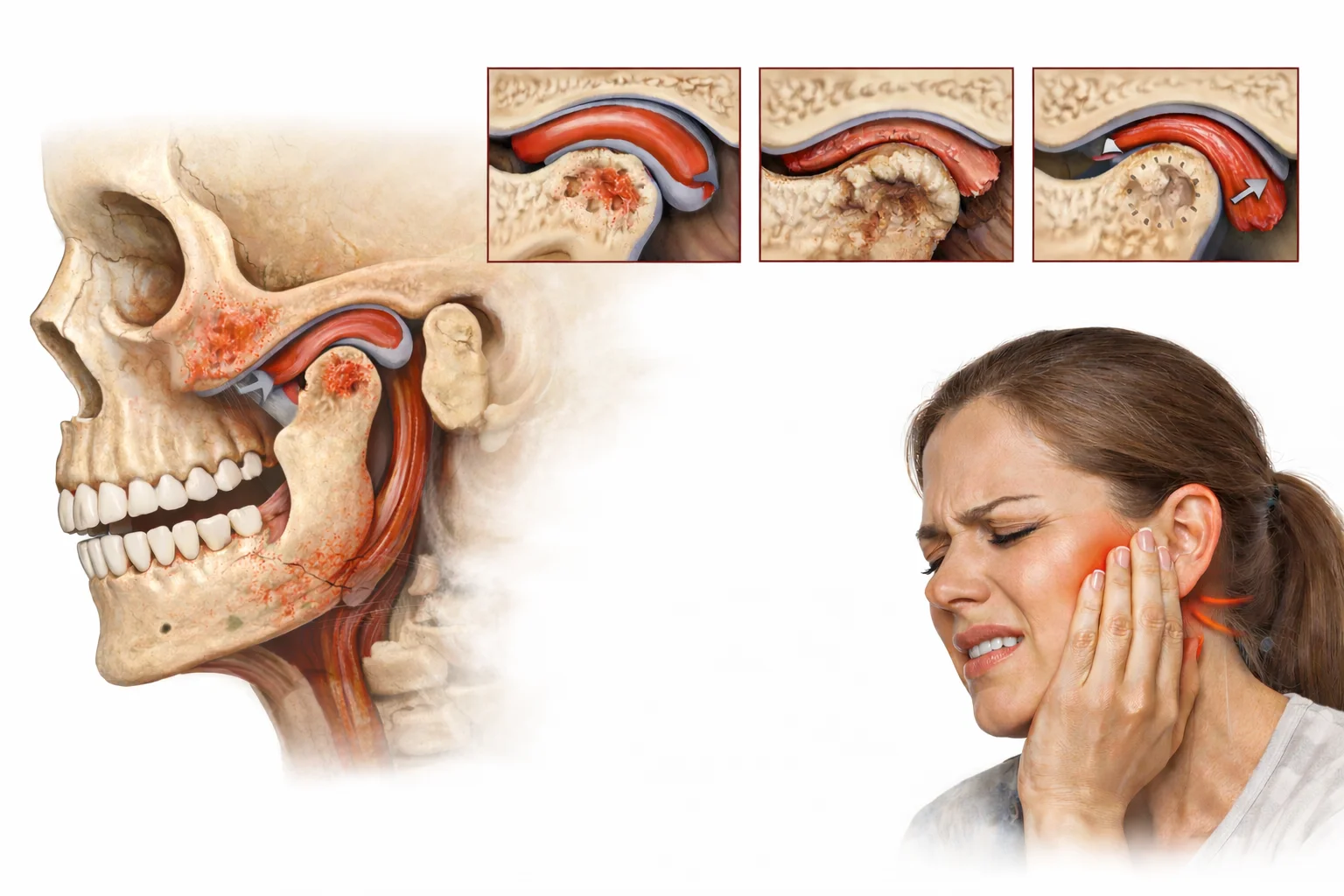
Temporomandibular joint (TMJ) and bruxism treatment is performed to clarify the causes of complaints such as teeth grinding, teeth clenching, jaw pain, jaw clicking/sounds, and tooth wear. In this treatment, the temporomandibular joint, TMJ status, occlusion (bite), chewing muscles, and the load distributed across the teeth are evaluated together.
Table of Contents
OpenBruxism is not just "nighttime teeth grinding." Some patients involuntarily clench their teeth during the day without realizing it, wake up with jaw fatigue in the morning, or notice wear on their teeth. In such cases, night guards, splint therapy, and regular follow-ups are selected following a clinical examination by a physician.
The goal is not simply to provide the patient with a mouthguard. The primary objective is to understand the load on the jaw joint, protect the teeth, investigate the causes of pain and tension, and establish a realistic, sustainable treatment plan for the patient.
What is TMJ and Bruxism Treatment?
TMJ and bruxism treatment involves the clinical evaluation of problems related to the temporomandibular joint, masticatory (chewing) muscles, teeth grinding, teeth clenching, and tooth wear. Depending on the patient's symptoms, treatment may include custom night guards, splint therapy, habit management, and regular follow-up examinations.
The most critical aspect in this field is isolating the root cause of the problem. Jaw pain may not be related to teeth grinding alone. Sometimes, occlusion, tooth wear, tension in the chewing muscles, stress, sleep habits, or temporomandibular joint disorders play a combined role.
TMJ and bruxism treatment is most frequently required in the following cases:
- Presence of nighttime teeth grinding;
- Awareness of daytime teeth clenching habits;
- Morning jaw pain and fatigue;
- Clicking or popping sounds coming from the jaw;
- Difficulty opening the mouth fully;
- Visible wear and flattening of the teeth;
- Pain felt around the head, temples, and ears;
- Frequent damage to fillings, veneers, or teeth;
- When the dentist detects an excessive load distributed on the teeth.
Treatment is not identical for every patient. For one patient, the primary need may be a night guard that protects the teeth. For another, jaw joint movement, occlusion, and muscle tension may need to be evaluated more comprehensively.
What do TMJ and Temporomandibular Joint mean?
TMJ stands for the temporomandibular joint, representing the joint area where the lower jaw connects to the skull. This joint functions during speaking, chewing, yawning, and opening or closing the mouth. When the joint, muscles, and teeth do not work harmoniously together, it can lead to pain, clicking sounds, and restricted movement.
Patients in Azerbaijan may see this term as TME (çənə-gicgah oynağı). In simple terms, it refers to the joint connecting the mandible to the skull, the movement of this joint, and how the surrounding muscles function.
Patients often describe TMJ problems by saying: "my jaw gets stuck," "there is a sound when I open my mouth," or "my jaw hurts when I chew." While these complaints may point to a temporomandibular joint issue, the precise cause can only be clarified during a clinical examination.
Why Do Bruxism and Teeth Grinding Occur?
Bruxism is an involuntary habit of clenching or grinding the teeth. This can occur during sleep at night or while awake during the day. The cause varies from patient to patient; stress, sleep disorders, misaligned bites (occlusion problems), lifestyle factors, and muscle tension can all contribute collectively.
Teeth grinding is sometimes unnoticed by the patient themselves. Family members might hear the sound at night, or a dentist may identify worn-down teeth during an examination. Other patients wake up in the morning feeling fatigue in their jaw, headaches, and tension in their teeth.
Possible causes of bruxism include:
- Stress and emotional tension;
- Teeth clenching habits during sleep;
- Unconscious daytime teeth clenching;
- Problems related to occlusion (bite alignment);
- Overstrain of the chewing muscles;
- Certain sleep disorders;
- Caffeine, smoking, and lifestyle factors;
- Side effects of certain medications;
- Uneven distribution of load on the teeth.
The key here is not to generalize a single cause to everyone. For example, bruxism may be predominantly stress-related in one patient, while in another, tooth wear, occlusion, and muscle tension may play a combined role.
What Are the Symptoms of a Jaw Joint Problem?
Jaw joint problems can present as jaw pain, clicking or popping sounds from the joint, inability to open the mouth fully, discomfort during chewing, morning jaw fatigue, and pain in the temple area. In some patients, tooth wear and tooth sensitivity can also be linked to bruxism.
Symptoms often start mild, and patients may ignore them for a long time. For instance, it may begin solely as a "clicking" sound, with pain during chewing or jaw tension adding up later. Timely examination is crucial in these cases.
Common symptoms associated with TMJ and bruxism include:
- Clicking or popping sounds from the jaw when opening the mouth;
- Morning jaw fatigue;
- A constant urge or sensation of clenching the teeth;
- The sound of teeth grinding at night;
- Wear on the edges of the teeth;
- Pain experienced while chewing;
- Tension in the temple area;
- A sensation of pain around the ears;
- Difficulty opening the mouth fully;
- Cracks, fractures, and sensitivity in the teeth.
All of these symptoms may not appear simultaneously. Sometimes, only tooth wear is visible without any pain. In other cases, there is no severe wear on the teeth, but tension in the muscles and jaw joint is much more pronounced.
How Does Bruxism Affect the Teeth and Jaw?
During bruxism, teeth can be subjected to pressure far exceeding normal chewing forces. This pressure can lead to tooth wear, sensitivity, cracks, fractured fillings, fatigue of the jaw muscles, and discomfort in the temporomandibular joint. If the problem is not monitored and addressed in time, damage can escalate.
Teeth are designed for daily chewing, but the load is entirely different when clenching or grinding occurs for hours at night. The patient might not feel it directly, but the dentist can observe flattened tooth tips, enamel wear, and broken restorations.
The impact of bruxism on the teeth and jaw can include:
- Wear on the incisal and occlusal surfaces of the teeth;
- Thinning of the tooth enamel;
- Increased tooth sensitivity;
- Premature failure and fracture of fillings;
- Excessive load on veneers and crowns;
- Fatigue of the masticatory muscles;
- Morning jaw pain;
- Additional strain on the temporomandibular joint;
- Headaches and temple pain;
- Discomfort when opening the mouth.
For instance, a patient might report that "my teeth look shorter" or "my fillings break frequently." Upon examination, the root cause may not be the quality of the filling itself, but rather teeth clenching and uneven load distribution.
How Is the Temporomandibular Joint Examined?
During a temporomandibular joint evaluation, the dentist examines the teeth, occlusion, jaw opening and closing movements, joint sounds, chewing muscles, and signs of tooth wear. When necessary, the patient's clinical history, pain points, and previous treatments are also taken into consideration.
This assessment goes beyond simply asking, "Is there a problem with the teeth?" In TMJ and bruxism treatment, the physician must understand the relationship between the teeth, muscles, and joints, because teeth clenching impacts the jaw muscles and joints just as much as the teeth themselves.
During the examination, the dentist may evaluate:
- Whether there is visible wear on the teeth;
- Areas of excessive load or interference in the bite;
- Whether sounds occur when the jaw opens and closes;
- Whether the degree of mouth opening is within normal limits;
- The presence of pain and tension in the chewing muscles;
- Complaints of morning pain and nighttime grinding;
- Cracks, fractures, and sensitivity in the teeth;
- Whether excessive loads are placed on existing fillings, veneers, and crowns.
In some cases, advanced imaging or cross-consultation with other specialists may be required. For example, if the pain is determined to be otogenic (ear-related), neurological, or originating from another source, the patient may be referred to the appropriate specialist.
What Is a Night Guard and Who Needs It?
A night guard is a custom-made oral appliance designed to protect the teeth from the excessive forces generated by nighttime clenching and grinding. While a mouthguard does not always stop bruxism entirely, it helps significantly reduce tooth wear, cracking, and the stress placed on dental restorations.
The night guard must be fabricated precisely to fit the patient's teeth. Pre-made, over-the-counter devices that do not match the patient's unique anatomy may fail to stay securely in place, irritate the gums, and cause additional discomfort to the jaw. Therefore, a guard should only be selected following a clinical dental evaluation.
A night guard may be necessary in the following situations:
- Presence of nighttime teeth grinding;
- Experiencing jaw fatigue upon waking up;
- Visible flattening or wear on the teeth;
- Frequent chipping or breaking of fillings;
- Chronically tense jaw muscles;
- When the dentist observes excessive load distribution on the dentition;
- When teeth need to be safeguarded due to active bruxism.
It is important to manage expectations correctly here. A mouthguard should not be marketed as a "definitive cure for bruxism." A more accurate framework is this: it helps protect teeth, redistributes load safely, and aids in relieving jaw tension for many patients.
Why Are Over-the-Counter Guards Not Equal to Custom Guards?
Because over-the-counter (ready-made) guards are not fabricated to fit an individual patient's specific dental anatomy, they cannot offer the same level of comfort and protection as a custom guard. A custom night guard is created from a precise impression or scan of the teeth, sits accurately in the mouth, and is verified by the dentist. This accuracy is vital for both tooth protection and jaw comfort.
Patients sometimes seek out ready-made guards from pharmacies or online marketplaces. However, these appliances can be overly bulky, fit poorly, and inadvertently introduce additional stress to the jaw joint. For a patient already dealing with bruxism and TMJ symptoms, this risk must be carefully evaluated.
Key advantages of custom guards include:
- Fabricated specifically to individual dental dimensions;
- Sits much more comfortably and securely in the mouth;
- Provides controlled and balanced load distribution across the teeth;
- Verified and adjusted directly by the dentist;
- Can be calibrated or modified if required;
- Far more suitable for long-term therapeutic use.
While ready-made guards are not inherently dangerous for everyone, self-selection without professional guidance is inappropriate for patients experiencing bruxism, jaw pain, or TMJ symptoms. The dentist must evaluate the teeth and jaw joint first.
What Is Splint Therapy?
Splint therapy is a targeted treatment approach utilizing a custom-fabricated oral appliance to precisely manage and control the load distributed across the temporomandibular joint, occlusion, and chewing muscles. Unlike a simple protective night guard, an occlusal splint is engineered with specific therapeutic goals for the jaw joint alignment and muscle deprogramming.
Splint therapy is never an automatic choice for every patient. The dentist first evaluates the primary complaints, tooth wear patterns, jaw mechanics, occlusion, and muscle trigger points. Following this, they explain whether a standard protective guard, an occlusal splint, or another approach is indicated.
Splint therapy may be indicated in the following scenarios:
- Presence of active pain within the jaw joint;
- Persistent clicking, popping, or grating sounds from the jaw;
- Discomfort or limitations during mouth opening;
- Severe muscle tension presenting alongside teeth clenching;
- When load distribution in the bite is actively causing structural issues;
- When a standard night guard proves insufficient;
- When the clinician needs to closely monitor and manage TMJ loading in detail.
Splint therapy should not be viewed as a single-session procedure. Following the fabrication and delivery of the appliance, compliance protocols, an adaptation phase, and routine clinical calibration check-ups are essential, as the jaw joint and neuromuscular system adapt dynamically over time.
What Is the Difference Between a Night Guard and Splint Therapy?
While a night guard and splint therapy may appear visually similar, they differ significantly in their clinical intent and scope of application. A night guard is primarily designed to shield the teeth from the structural wear of bruxism. In contrast, splint therapy is chosen to dynamically manage jaw joint positioning, muscle hypertonicity, and occlusal forces in a comprehensive manner.
For the patient, the core question should not be "which one is better?" The more appropriate question is: which specific appliance corresponds correctly to my clinical symptoms, dentition, jaw joint status, and severity of bruxism?
| Topic | Night Protective Guard | Splint Therapy |
|---|---|---|
| Primary Goal | To protect teeth from clenching and grinding forces | To manage jaw joint, muscle, and occlusal loads in a controlled manner |
| Area of Use | Bruxism, tooth wear, nighttime teeth grinding | TMJ disorders, jaw pain, muscle tension, occlusal load management |
| Fabrication | Made from custom dental impressions | Made from custom impressions with a highly detailed clinical plan |
| Follow-up Need | Required | May be more critical and frequent |
| Expectation | Helps protect teeth from structural damage | Helps manage systemic load based on specific symptoms |
| Who Decides? | The dentist, after clinical examination | The dentist, after clinical examination |
For some patients, a standard night guard is entirely sufficient. For others presenting with more acute jaw joint and neuromuscular complaints, splint therapy is far more appropriate. This therapeutic pathway should never be determined without a comprehensive clinical examination.
Are Bruxism and Jaw Joint Problems the Same Thing?
Bruxism and jaw joint problems are not identical diagnoses, though they are frequently interconnected. Bruxism refers specifically to the habit of clenching or grinding teeth. A jaw joint problem, or TMJ disorder, manifests as pain, clicking sounds, and functional limitations involving the temporomandibular joint, chewing muscles, and mandibular movement.
In many individuals, bruxism introduces excessive, repetitive loading onto the temporomandibular joint structure. This can precipitate morning jaw stiffness, temple headaches, and discomfort during chewing. However, it is important to note that not every jaw joint disorder is caused by bruxism.
| Topic | Bruxism | Jaw Joint Problem (TMJ) |
|---|---|---|
| Core Meaning | Teeth clenching or teeth grinding habit | Temporomandibular joint and muscle dysfunction |
| Typical Symptom | Tooth wear, night grinding sounds, morning fatigue | Jaw clicking/popping, local pain, restricted opening |
| Area of Impact | Teeth, restorations, chewing muscles | TMJ assembly, masticatory muscles, jaw mechanics |
| Treatment Approach | Mouthguards, habit management, etiology research | Splints, therapeutic exercises, monitoring, further diagnostics |
| Interconnection | Can significantly increase joint loading | Can frequently present concurrently with bruxism |
Clarifying this distinction is essential for patients. Often, a patient may request a basic night guard assuming it solves everything, whereas their primary pathology may demand targeted therapy for jaw joint and muscle dysfunction.
How Long Does TMJ and Bruxism Treatment Take?
The duration of TMJ and bruxism treatment varies depending on the patient's individual symptoms, the severity of the bruxism, the degree of tooth wear, jaw pain levels, and the specific appliance selected. Once the night guard or splint is delivered, clinical success depends heavily on patient compliance and regular follow-up tracking.
Some patients adapt to wearing an appliance very quickly, while others require an incremental adjustment period. In cases involving severe jaw joint or neuromuscular tension, merely delivering an appliance may not suffice; the dentist must clearly outline usage rules, tracking intervals, and supportive therapies.
Factors influencing the treatment timeline include:
- Whether bruxism occurs nocturnally, diurnally, or both;
- The extent of structural wear on the teeth;
- The presence or absence of acute jaw joint pain;
- The level of surrounding muscle tension;
- The baseline status of the patient's occlusion;
- Correct and consistent use of the guard or splint;
- Adherence to scheduled clinical follow-up visits;
- Stress levels and related daily habits.
Promising an absolute recovery within a few days is clinically inaccurate. A realistic approach involves a thorough clinical diagnosis, setting up an appliance and monitoring framework, and tracking how symptoms evolve over time.
Who is TMJ and Bruxism Treatment Not Suitable For?
In the management of TMJ and bruxism, a night guard or splint is not automatically prescribed to every presenting patient. If acute trauma, active infection, suspected otogenic or neurological pathologies, severe acute restriction in mouth opening, or other underlying systemic diseases are present, the primary cause must be diagnosed first.
The most counterproductive approach in this field is assuming every instance of jaw pain stems from simple bruxism. Jaw-area pain can be linked to teeth, periodontal structures, the joint complex, musculature, ears, sinuses, or neurological pathways. Thus, a comprehensive evaluation remains mandatory.
Scenarios requiring heightened clinical caution include:
- Recent history of jaw or facial trauma;
- Sudden, acute locking of the jaw joint;
- Severe, acute restriction of mouth opening;
- Intense, unremitting, or continuous localized pain;
- High probability of primary otogenic or neurological causes;
- Active dental or periodontal infections;
- When a patient is unable or unsuited to comply with oral appliance usage instructions;
- When pain escalates sharply and exclusively in one specific zone;
- When the dentist deems an interdisciplinary specialist evaluation necessary.
In these cases, diagnostic priority is placed on identifying the root cause. Sometimes targeted dental treatment is sufficient, while at other times, referring the patient to a medical specialist is the correct clinical pathway.
What Does the Cost of TMJ and Bruxism Treatment Depend On?
The cost of TMJ and bruxism treatment depends on the scope of the diagnostic phase, the choice between a night guard or advanced splint therapy, the materials utilized, laboratory fabrication fees, calibration requirements, and the frequency of follow-up monitoring visits. An accurate fee structure can only be determined following a comprehensive clinical examination.
The exact same complaint of "teeth grinding" can require vastly different treatment protocols across different patients. One individual may only require a straightforward custom night guard, whereas another presenting with complex TMJ symptoms, joint pain, and muscle hypertonicity will require splint therapy and close clinical supervision.
Primary factors influencing the total cost include:
- The scope of the initial diagnostic evaluation;
- Clinical impressions or digital scanning procedures;
- The indication for a custom protective night guard;
- The indication for comprehensive splint therapy;
- The choice of dental materials used for fabrication;
- Dental laboratory fabrication complexity;
- In-office calibration and balancing of the appliance;
- The number of scheduled follow-up tracking visits;
- The extent of existing tooth wear requiring restorative therapy;
- The severity and chronicity of the TMJ pathology.
Providing definitive pricing over the telephone is impractical, as the individual state of the jaw joint, occlusal relationships, structural tooth wear, and specific bruxism levels cannot be accurately assessed without a direct clinical evaluation.
What Should You Look For When Choosing a Dentist for TMJ and Bruxism Treatment in Baku?
When selecting a dentist for TMJ and bruxism treatment in Baku, focusing solely on the price or the provision of a basic mouthguard is an inadequate approach. It is vital that the clinician evaluates the temporomandibular joint mechanics, occlusal relationships, tooth wear patterns, masticatory musculature, and the patient's wider clinical history in unison.
A high standard of care in this discipline does not end with simply instructing a patient to "wear this at night." The dentist should clearly explain the potential underlying triggers of the problem before confirming the necessity of a night guard or splint.
Patients can consider the following questions when choosing their treating clinician:
- Does the dentist systematically evaluate the temporomandibular joint?
- Are occlusal relationships and tooth wear patterns thoroughly checked?
- Is the clinical distinction between teeth grinding and teeth clenching explained?
- Are the different roles of a night guard versus splint therapy clearly communicated?
- Is the difference between an over-the-counter guard and a custom guard clarified?
- Is it properly explained that a guard protects the structures rather than serving as an instant cure-all for bruxism?
- Is a clear, long-term follow-up schedule provided?
- Are realistic expectations regarding treatment outcomes established from the start?
If you are experiencing morning jaw fatigue, joint clicking, or noticeable wear on your teeth, seeking a timely clinical examination is the most appropriate step. Early intervention helps safeguard both your dentition and jaw joint health effectively.
What Does Dr. Ummahani Huseynova Focus on in This Treatment?
Dr. Ummahani Huseynova does not look at the complaint of teeth grinding in isolation during TMJ and bruxism treatments. Tooth wear metrics, occlusal parameters, temporomandibular joint mobility, the tone of the chewing muscles, morning pain incidents, nighttime habits, and the patient's day-to-day symptoms are all factored into the diagnostic equation collectively.
The goal is never to simply hand over a standard night guard. The core objective is to ascertain the extent of the stress caused by teeth clenching, determine whether the jaw joint is bearing an unsafe load, and isolate exactly which appliance best fits the patient's clinical needs.
During the examination, the patterns of wear on the tooth surfaces are analyzed first. The load distributed across existing fillings, veneers, or crowns is verified alongside bite alignment and localized tooth sensitivity. Any clicking sounds, localized pain, or physical limitations when opening or closing the mouth are carefully documented.
Following this review, the clinical necessity for a custom night guard, splint therapy, or specific follow-up schedules is communicated to the patient. The function of each appliance is explained in clear terms: what structures it protects, what parameters it can alter, and what therapeutic outcomes are realistic to expect.
In Dr. Ummahani Huseynova’s clinical approach, TMJ and bruxism management is structured not as a one-off delivery of an appliance, but as an ongoing therapeutic process focused on understanding root causes, preserving dentition, monitoring joint loading, and providing appropriate patient guidance.
Frequently Asked Questions
This section provides direct, concise answers to the questions most frequently asked by patients regarding TMJ and bruxism treatments. The answers explain teeth grinding, clenching, TMJ functions, night guards, splint therapy, costs, treatment timelines, and why a professional clinical examination is essential.
What is bruxism?
Are teeth grinding and teeth clenching the same thing?
What causes bruxism?
If my jaw makes a sound, does it mean I have a TMJ problem?
Does a night guard completely cure bruxism?
How is a custom night guard made?
What is splint therapy?
What is the difference between a night guard and splint therapy?
Can bruxism cause headaches and jaw pain?
If my teeth are already worn down, will a night guard be enough?
Is an MRI necessary for jaw joint problems?
What does the cost of bruxism treatment depend on?
Conclusion
Temporomandibular joint and bruxism treatment is vital to understanding the root causes of issues like teeth grinding, teeth clenching, jaw pain, joint sounds, and tooth wear. Proper management in this field goes beyond simply providing a mouthguard; the jaw joint, occlusion, muscles, and teeth must be evaluated systematically as a unified system.
A custom night guard can successfully protect teeth from the excessive loads of bruxism, while splint therapy is implemented in specific cases to precisely govern the forces acting upon the jaw joint and masticatory muscles. Discovering which approach aligns with your needs is only possible through a clinical consultation.
If you regularly notice morning jaw fatigue, teeth clenching, teeth grinding, clicking joint sounds, or visible flattening of your teeth, diagnosing the exact cause requires a professional assessment. You can schedule a clinical evaluation with Dr. Ummahani Huseynova to determine the most effective treatment plan across TMJ care, bruxism management, custom night guards, and splint therapy tailored to your condition.