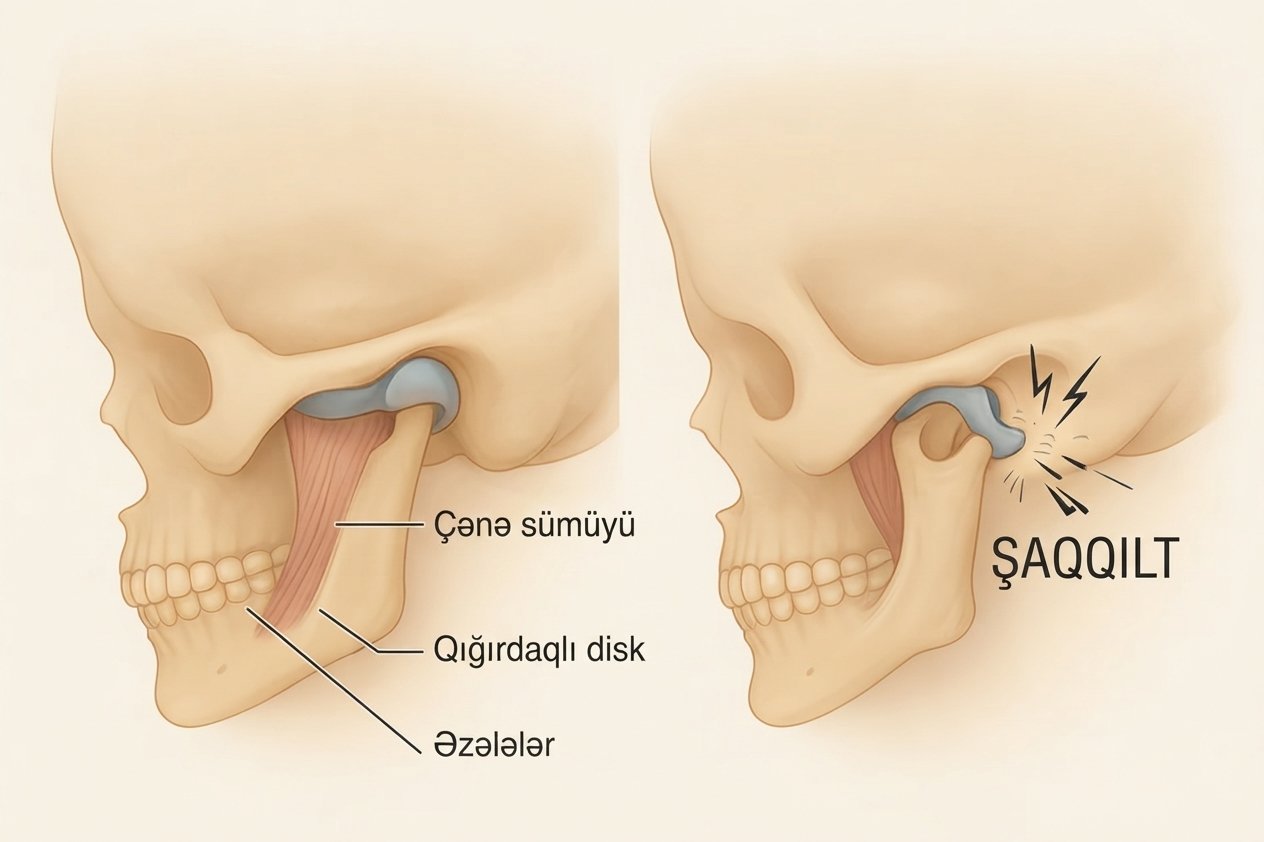
Jaw clicking, hearing a sound when opening the mouth, and pain in the jaw joint are among the complaints encountered in dental practice. These symptoms can be related to changes in the movement of the joint disc, teeth clenching and grinding, tension in the masticatory muscles, trauma, arthritis, and degenerative changes on the joint surfaces.
Table of Contents
OpenA painless click heard while opening and closing the mouth is common in many people and does not always require treatment. If the sound is accompanied by pain, jaw locking, reduced mouth opening, and difficulty chewing, a clinical evaluation of the temporomandibular joint is essential.
In Dr. Ummahani Huseynova's clinical practice, rather than the sound from the jaw itself, what complaints accompany the sound is evaluated. The same complaint of "my jaw is clicking" may be associated with a painless joint sound in one patient, and disc displacement, bruxism, or muscle tension in another.
What is the temporomandibular joint?
The temporomandibular joint is a paired joint connecting the mandible to the temporal bone of the skull. Located in front of the ear, these joints work when speaking, chewing, swallowing, yawning, and opening and closing the mouth.
Inside the joint, a disc is located between the bone surfaces. The disc helps the smooth movement of the jaw and the distribution of load between the joint surfaces.
Pain and functional disorders related to the temporomandibular joint, joint disc, and masticatory muscles are evaluated under the name of temporomandibular disorders (TMD). TMJ is the international term expressing the temporomandibular joint itself.
Do jaw clicking and grinding mean the same thing?
Patients can describe different sounds coming from the jaw as "grinding," "snapping," "clicking," or "friction sound." Clinically, the characteristics of these sounds can vary.
Jaw clicking and snapping
A short clicking sound heard when opening or closing the mouth may be related to the movement of the joint disc. Clicking may occur when the disc slips from its normal position and comes back into a matching position with the joint condyle during jaw movement.
If clicking does not cause pain and does not limit jaw movement, it often does not require intervention.
Jaw grinding and crepitus
A rough and continuous sound reminiscent of sand grains rubbing together is called crepitus. Such a sound can be observed during degenerative changes on the joint surfaces.
If grinding is accompanied by pain, stiffness, and reduced mouth opening, there may be a need for a detailed evaluation of joint structures.
What are the main causes of jaw joint grinding and pain?
The cause of jaw joint pain is not the same in every patient. The problem can stem from structures inside the joint, the masticatory muscles, or the combined effect of several factors.
Displacement of the joint disc
The disc in the temporomandibular joint moves in coordination with the joint condyle as the lower jaw moves. When the position and movement trajectory of the disc change, clicking, catching sensations, pain, and limitation in mouth opening can occur.
Some patients report that they first felt a clicking sound and later could not open their mouth as wide as before. Such a change provides the basis for a clinical examination of the jaw joint.
Teeth clenching and bruxism
Bruxism can manifest as teeth grinding during sleep or clenching teeth while awake. During this time, the load on the masticatory muscles increases.
Morning jaw fatigue, temple pain, wear on tooth surfaces, tooth sensitivity, and tension in the masticatory muscles may suggest the possibility of bruxism.
A diagnosis of bruxism is not made based on a single one of these symptoms. Teeth, masticatory muscles, jaw movement, and the patient's complaints are evaluated together.
Tension of the masticatory muscles
The source of jaw pain sometimes stems from the masticatory muscles rather than the joint itself. Muscle-derived pain can radiate to the pre-auricular, cheek, temple, and neck regions.
Clenching teeth for a long time, chewing gum frequently, and keeping the jaw in a tense position can increase the load on the masticatory muscles.
Trauma to the jaw
A blow to the face and jaw region, sports trauma, an accident, or sudden excessive opening of the mouth can affect joint structures.
Pain starting after trauma, a newly developed sound, reduced mouth opening, and a different occlusion of teeth than before are reasons for examination.
Arthritis and degenerative joint changes
Osteoarthritis and other joint diseases can occur in the temporomandibular joint. In such cases, pain, stiffness, movement restriction, and crepitus can be observed.
A rough friction sound may suggest the possibility of changes on the joint surfaces. Diagnosis is made by evaluating the characteristics of the sound, clinical examination, and imaging results if needed.
Is it dangerous to have a sound coming from the jaw when opening the mouth?
Clicking that does not cause pain and does not limit jaw movement is found in many people. Such a sound does not always mean a jaw joint disease or a need for treatment.
A dental examination is recommended if any of the following symptoms occur:
- If the click or grinding becomes painful;
- If the mouth does not open as wide as before;
- If the jaw catches while opening or closing;
- If the jaw locks;
- If pain occurs during chewing;
- If the direction of jaw movement changes;
- If the sound started after trauma.
Rather than the loudness of the sound, pain and changes occurring in jaw function carry clinical significance.
Can jaw joint pain radiate to the ear and temple?
The temporomandibular joint is located in front of the ear. Some of the masticatory muscles have an anatomical connection with the temporal region. Therefore, joint- and muscle-derived pain can be felt in the pre-auricular, temple, cheek, face, and neck regions. NIDCR lists pain radiating to the face and neck among the symptoms encountered during TMD.
The patient may feel pain around the ear and tension in the temple when chewing. Other causes of long-lasting ear pain should be considered, and an examination by an appropriate specialist physician should be conducted if necessary.
Can morning jaw pain be a sign of bruxism?
Pain, fatigue in the jaw upon waking in the morning, and tension in the temporal region may suggest the possibility of night teeth clenching or grinding.
Symptoms that can be associated with bruxism include:
- Morning jaw fatigue;
- Pain in the temporal region;
- Wear on tooth surfaces;
- Cracks and sensitivity in teeth;
- Tension in the masticatory muscles;
- Teeth grinding sounds during sleep heard by close ones.
Because tooth wear can occur for different reasons, bruxism evaluation is not conducted based on a single symptom.
Can stress increase jaw pain?
Stress is not evaluated as the sole cause of temporomandibular joint problems. During stressful periods, the habit of clenching teeth, tension in the masticatory muscles, sleep problems, and pain sensitivity can increase.
For this reason, some patients may feel morning jaw fatigue, temple pain, and teeth clenching more during tense periods.
Modern TMD approaches evaluate these problems within the framework of the mutual interaction of biological, behavioral, and psychosocial factors.
Is incorrect occlusion of teeth the main cause of jaw pain?
Explaining jaw joint problems through tooth occlusion in every situation does not align with modern scientific approaches. Existing evidence does not confirm a strong universal causal relationship between malocclusion and TMD.
The tooth occlusion of a patient with a jaw joint problem is examined. Along with this, the joint, disc, masticatory muscles, bruxism symptoms, jaw movement, and characteristics of pain are considered together.
Grinding teeth and irreversibly changing occlusion to eliminate TMD pain is not considered a standard initial approach.
What symptoms can manifest in jaw joint problems?
The following symptoms can be observed in problems related to the temporomandibular joint and masticatory muscles:
- Jaw pain in front of the ear;
- Sound coming from the jaw when opening the mouth;
- Painful clicking and grinding;
- Pain increasing during chewing;
- Decrease in mouth opening;
- Locking of the jaw;
- Deviation of the jaw to the side when opening;
- Pain radiating to the temple and facial region;
- Morning jaw fatigue;
- Teeth clenching and grinding;
- Wear on tooth surfaces.
The duration of complaints, intensity of pain, and its effect on chewing function are separately considered during the examination.
How is the jaw joint examined?
The evaluation of a jaw joint problem begins with a detailed listening to the patient's complaint and a clinical examination.
The physician can evaluate the location of the pain, when it started, with which movement it increases, how much the jaw opens, the movement trajectory, joint sounds, the condition of the masticatory muscles, and signs of wear on tooth surfaces.
An MRI or CBCT is not required for every jaw sound. The imaging method is chosen according to the question that needs to be answered in the clinical examination.
When is an MRI used for the jaw joint?
MRI is used for the evaluation of the joint disc and soft tissues.
When information about the position, shape, and soft tissue changes within the joint of the disc is needed, MRI is an informative examination method. MRI is the main imaging method that reliably shows the joint disc.
When is CBCT used?
Cone-beam computed tomography (CBCT) is used to evaluate the bone structures of the jaw joint in detail.
When trauma, bone changes in the joint condyle, and suspicion of a degenerative process arise, CBCT can provide useful information.
MRI and CBCT evaluate different anatomical structures. MRI provides more detailed information about soft tissues and the disc, while CBCT provides more detailed information about bone structures.
How are grinding and pain in the jaw joint treated?
Treatment is chosen based on the source of the pain and the characteristics of the jaw joint problem. In modern TMD approaches, conservative and reversible methods are preferred in the initial stage.
During periods when complaints increase, reducing the load on the jaw, staying away from hard foods requiring prolonged chewing, avoiding chewing gum, not deliberately clicking the jaw, and keeping the teeth clenching habit under control may be recommended.
Physical therapy and special jaw exercises can be used in suitable patients. Individually prepared splints or night guards in bruxism and certain forms of TMD can be included in the treatment plan after a clinical examination.
Surgical interventions are not chosen as an initial treatment method during TMD. Additional interventions may be considered in selected patients with serious structural and functional problems who do not achieve results from simpler and conservative approaches.
Which doctor should be consulted for jaw joint and bruxism problems?
In cases of sound coming from the jaw, jaw pain, teeth clenchnig, morning jaw fatigue, limited mouth opening, and jaw locking, it is appropriate to consult a dentist who evaluates the function of the temporomandibular joint, masticatory muscles, and bruxism symptoms together.
What does condylography show in the evaluation of jaw movements?
When there is a need for functional evaluation, condylography can be used. Condylography digitally records the movement trajectory of the joint condyles during opening-closing, forward, and side movements of the lower jaw.
The obtained data, evaluated together with clinical examination results, helps to analyze the characteristics of jaw movements in more detail and prepare an individualized treatment plan.
Condylography does not replace clinical examination. Functional data is evaluated together with the patient's complaints and other examination results.
How is jaw joint and bruxism treatment planned?
The cause of the problem is not the same in every patient with a sound coming from the jaw. Therefore, treatment is not planned as a ready-made standard package, but individually based on the result of clinical and functional evaluation.
Management of the load on the jaw, control of bruxism, individual splints, functional observation, and control examinations can be planned according to the patient's condition.
If jaw pain, teeth clenching, morning jaw fatigue, or sounds coming from the jaw persist, you can book an appointment with Dr. Ummahani Huseynova for an evaluation of the functional state of the jaw joint.
When is it necessary to consult a doctor for jaw joint pain?
It is advisable not to delay the examination in the following cases:
- If the pain persists or gradually increases;
- If the mouth does not open as wide as before;
- If the jaw locks frequently;
- If chewing becomes difficult;
- If pain starts after trauma;
- If a sudden change in tooth occlusion is felt;
- If swelling occurs in the face and jaw region;
- If there are signs of fever and infection.
Inability to move the jaw after trauma, rapidly increasing swelling, and difficulty swallowing or breathing may require urgent medical evaluation.
Frequently asked questions about jaw joint grinding and pain
Is it normal to hear a sound from the jaw when opening the mouth?
Can jaw joint pain radiate to the ear?
What can morning jaw pain indicate?
If there is a jaw click, does it need to be corrected?
When should MRI or CBCT be used for the jaw joint?
Can crepitus in the jaw joint decrease?
How are jaw joint problems treated?
When should you see a doctor for jaw sound and pain?
The source of the problem may be joint disc displacement, bruxism, muscle tension, trauma, degenerative joint changes, or other factors. After a clinical evaluation, a personalized treatment plan is scheduled based on the patient's clinical and functional findings.
Dr. Ummahani Huseynova's clinic evaluates the jaw joint and bruxism symptoms clinically, and functionally if needed.
If jaw pain, clenching, and muscle tension persist, postponing the examination is not the right approach.
Sources
- National Institute of Dental and Craniofacial Research. Temporomandibular Disorders (TMD).
- Manfredini D, Häggman-Henrikson B, Al Jaghsi A et al. Temporomandibular disorders: INfORM/IADR key points for good clinical practice based on standard of care. Cranio. 2025;43(1):1–5. DOI: 10.1080/08869634.2024.2405298.
- Mallya SM et al. Recommendations for Imaging of the Temporomandibular Joint. Position Statement from the American Academy of Oral and Maxillofacial Radiology and the American Academy of Orofacial Pain.